 Animation — Advanced Creature Animation Course
Quadruped Animation:
Common Mistakes and Fixes
Quadruped animation mistakes are some of the most common issues holding back creature animators. Animating quadrupeds is one of the most challenging skills in character animation. Learning to avoid quadruped animation mistakes is essential for creating realistic animal or creature motion. Even small errors in weight, timing, or structure can immediately break the illusion.
In this guide, we’ll cover the 11 most common quadruped animation mistakes and, importantly, how to fix them using a production-focused approach.
Why Quadruped Animation Is So Difficult
Coordinating the movement of four legs and the spine requires precise timing and weight distribution.
The 11 Mistakes
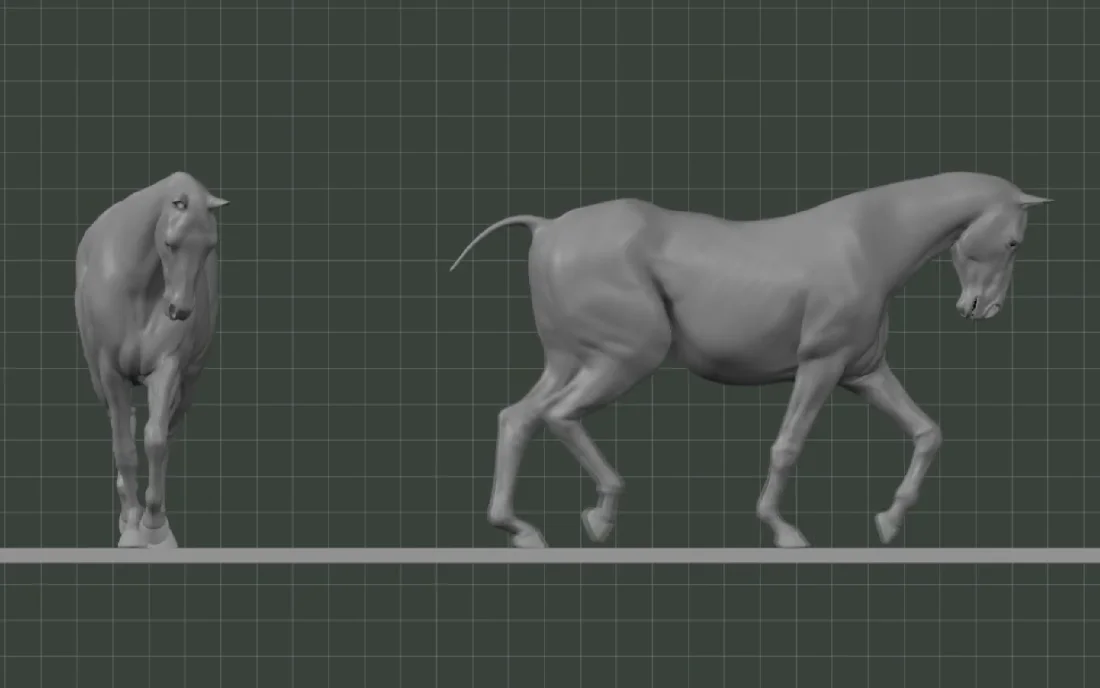
Quadruped Animation Mistake #1: Ignoring Real-World Biomechanics
Animators often jump straight into animating quadrupeds without carefully studying how real animals move. This is especially common when working under tight deadlines or when animators are used to bipeds. The result? Legs that don’t hit the ground convincingly, bodies that seem to float, and overall motion that feels disconnected from reality. Even small errors in biomechanics can make a quadruped walk or run look “off,” breaking the illusion instantly.
- Dogs and cats → flexible, dynamic
- Horses and large animals → structured rhythm
- Creatures → believable hybrid logic
Fix:
The same principle applies when animating extinct animals — read how we approach reference in the Dinosaur Animation Workflow.
Quadruped Animation Mistake #2: Weak Weight Distribution
A believable quadruped always feels grounded. One of the most common mistakes is uneven or floating weight. Animators might give each foot equal timing or ignore how the center of mass shifts as the animal walks, trots, or runs. This creates animations that feel disconnected from gravity and mass, even if the leg movements themselves look correct. Animations feel ungrounded if the weight isn’t handled correctly. Common issues:
- Floating body
- No clear foot impact
- Even timing regardless of mass
Fix:
Quadruped Animation Mistake #3: Stiff Spine and Torso
The spine is the engine of a quadruped’s motion. A rigid torso prevents energy from flowing naturally, making movements robotic. Many beginners key the torso in blocks or keep all controls on the same frame, which kills the subtle arcs and waves that make a creature feel alive. Without a flexible spine, even a perfectly timed gait can feel mechanical.
This challenge becomes even more complex with creatures and dinosaurs, where anatomical constraints — not just animation principles — dictate how much the spine can flex. Understanding which vertebral sections move and which are effectively locked is a skill that separates production-level work from demo reel exercises.
Fix:
Spine rigidity in creatures is covered in depth in our Creature Animation Course — with species-specific breakdowns.
Quadruped Animation Mistake #4: Poor Leg Coordination
Quadrupeds follow precise leg patterns for walking, trotting, or galloping. A common error is breaking these patterns, causing the legs to collide, float, or move out of sync. Even small misalignments in spacing or timing can immediately alert the viewer that something is off, disrupting suspension of disbelief.
Gait patterns are not arbitrary — they are biomechanically determined by body mass, limb length, and locomotion speed. The same species will use different leg coordination patterns depending on how fast it is moving. Mixing a trot pattern with a gallop speed, for example, is one of the most common errors in creature animation at the junior level.
Fix:
Quadruped Animation Mistake #5: Unnatural Head and Tail Motion
Animators often treat the head and tail as secondary or optional. The mistake is animating them independently of the main body or leaving them static. Without proper head and tail motion, the character can look stiff, disconnected, or emotionally flat. The flow of the tail and the orientation of the head provide visual cues about energy, balance, and intent.
In production, the head and tail are often what sells the creature’s internal life — its awareness, its fatigue, its predatory focus. A technically perfect gait with a locked head reads as a video game asset, not a cinematic creature performance.
Fix:
Head and tail performance is a core focus of our Advanced Creature Animation Course — where we animate full creature shots from blocking to final polish.
Quadruped Animation Mistake #6: Missing Overlap and Secondary Motion
Secondary motion — such as follow-through in the spine, tail, or shoulders — is what gives quadrupeds life. Beginners often animate body parts simultaneously, creating stiff, unnatural motion. Proper overlap ensures that energy transfers realistically across the body, making each step and movement feel organic.
In a dailies context, missing overlap is one of the fastest ways to get sent back to blocking. It is not a polish step — it is a structural part of the animation that must be planned from the very first pass. If your blocking does not account for how energy flows through the body, adding overlap later becomes an expensive fix.
Fix:
Quadruped Animation Mistake #7: Not Analysing Reference Properly
Simply watching reference is not enough. Most junior animators play back footage at full speed, note the general shape of the movement, and then attempt to recreate it from memory. The result is an animation that captures the feeling of the motion without any of the underlying structure — the specific timing of foot contacts, the precise way the body rises and falls, the exact frame where weight shifts from one side to the other.
Reference analysis is a skill in itself. It requires stepping through footage frame by frame, identifying the mechanical phases of the gait, and extracting timing data that can be applied directly to your scene. The difference between an animator who watches reference and one who studies it is visible in every frame of the final shot.
Fix:
Quadruped Animation Mistake #8: Confusing the Walk With the Trot
This one is worth stating plainly, because a lot of the guidance online gets it backwards. Most quadruped guides open by telling you that a walking animal moves its legs in diagonal pairs — front-left with hind-right, front-right with hind-left, each pair leaving the ground together. That is not the walk. That is the trot.
A walk is a four-beat gait. The feet land one at a time, in a lateral sequence, and at any given moment three feet are still supporting the body. That is precisely what makes it a walk: the animal is never airborne and never balanced on a single diagonal. The trot is a two-beat gait, where the diagonal pairs genuinely do move together and only two feet carry the weight. Build a walk on diagonal-pair timing and you will produce a slow, floaty trot — which is exactly what most junior quadruped reels look like.
| Gait | Beats | Footfall order | Feet on ground |
|---|---|---|---|
| Walk | Four | Hind-left → front-left → hind-right → front-right | Three, briefly two |
| Trot | Two | Hind-left + front-right, then hind-right + front-left | Two, with a suspension phase |
The pattern holds across species with very different proportions. A horse and a dog both walk in a four-beat lateral sequence, even though the timing between beats and the amount of overlap differ considerably. What changes with size is the rhythm, not the order.
Fix:
Gait selection for invented anatomy is a module of its own in the Advanced Creature Animation Course.
Quadruped Animation Mistake #9: Animating a Cycle When the Shot Needs a Shot
Nobody is hired to deliver a walk cycle. A cycle is where you start; a shot is what gets reviewed. And the single most common failure in that transition is foot sliding — feet that skate along the ground instead of planting.
It comes from one of two places. Either the walk on the spot was never set up correctly to begin with, so the contacts do not hold still while the body passes over them. Or the cycle was clean in place and then converted to a walk across without doing the arithmetic: the root translation per cycle has to match the actual ground distance the feet cover, exactly. Miss it by a few units and every step slides a little. Miss it by more and the animal looks like it is on a treadmill someone is dragging.
The maths is not complicated, but it has to be done rather than eyeballed. Measure the distance between two consecutive contacts of the same foot — that is your stride length. Over one full cycle, the root must travel exactly that distance times the number of strides in the cycle. If it travels less, the feet slide forward; if it travels more, they slide back.
Fix:
Quadruped Animation Mistake #10: Treating a Turn Like a Walk That Curves
Turning is where quadruped reels fall apart, and it is barely covered anywhere. Most animators take a straight-line cycle and rotate the root along an arc. The result reads as a stiff toy being steered, because a turning quadruped changes almost everything about how it steps.
The body yaws into the curve, so the heading direction is shifting continuously rather than being set once. The inner legs take shorter steps with a reduced range of motion while the outer legs take longer ones to cover the greater distance around the arc. And the feet no longer land on the same lines they would when walking straight: they place slightly outward or inward of the centreline to keep balance and to avoid the animal tripping over its own adjacent limbs.
Underneath that, the forces change too. More weight shifts onto the outer legs to counter the outward push of the turn. The legs push sideways as well as forward, because that lateral component is what actually curves the path of the centre of mass. And the joint angles stop being symmetrical — hips and shoulders bend more on one side of the body than the other, for the entire duration of the turn.
Fix:
Turns, stops and direction changes are built shot by shot in the Creature Animation Course.
Quadruped Animation Mistake #11: Animating Every Shot on Flat Ground
Almost every quadruped tutorial online animates on a perfectly flat plane. Almost no production shot does. The moment your creature walks up a bank, down a slope, or across broken ground, a cycle built for flat terrain stops working — and the reason is the same principle that governs turning: the body has to rebalance.
Going downhill, the centre of mass wants to run ahead of the animal, so the body leans back to resist it. That changes the geometry of the legs directly: the hind legs stay shorter and more compressed underneath the body, while the front legs extend further out to catch and brake each step. Going uphill it inverts — the body pitches forward into the climb, the front legs fold up shorter to reach the higher ground, and the hind legs extend to drive the mass upward.
This is not a polish adjustment. It changes contact positions, limb extension, and the timing of the push-off, which means it has to be present from blocking. Bolting a lean onto a finished flat cycle produces an animal that looks like it is sliding down a ramp rather than walking on one.
Fix:
Final Thoughts on Quadruped Animation Mistakes
Strong quadruped animation relies on three fundamentals:
- Clear weight and grounded foot contact
- Solid gait timing built on real biomechanics
- Natural motion flow from spine through tail
If these work, the animation feels believable. If not, no amount of spline polish or secondary motion will fix it. Correct the structure first — everything else builds on top of it.
And then there is the part that separates a reel exercise from a production shot: the animal has to walk, not trot; the cycle has to become a shot without sliding; and it has to turn and handle a slope without falling back on flat-ground timing. That is the work that actually gets looked at.
Quadruped Animation Mistakes: FAQ
Do quadrupeds walk using diagonal leg pairs?
No — that describes the trot. A walk is a four-beat gait in which the feet land one at a time in a lateral sequence, with three feet supporting the body for most of the cycle. Diagonal pairs moving together is the two-beat trot. Confusing the two is one of the most common causes of floaty quadruped animation.
Why do my quadruped’s feet slide along the ground?
Almost always because the root translation does not match the measured stride length. Either the walk on the spot was never holding its contacts properly, or the conversion to a walk across was estimated by eye instead of calculated. Check it in stepped, with a ground plane visible, before going to spline.
How do I animate a quadruped turning?
Not by rotating a straight cycle along a path. The inner legs take shorter steps with less range while the outer legs take longer ones, weight shifts onto the outer side, the legs push laterally as well as forward, and the hips and shoulders stay asymmetrical for the whole turn.
What changes when a quadruped walks on a slope?
The body rebalances against gravity, and the limbs follow. Downhill the body leans back, the hind legs stay compressed and the front legs extend to brake. Uphill the body pitches forward, the front legs fold shorter and the hind legs extend to drive. Both need to be built into blocking, not added afterwards.
How long does it take to animate a good quadruped walk cycle?
Less time than most animators expect once the gait, the stride length and the contact positions are decided before blocking — and far longer than expected when they are not. The cycle itself is rarely the bottleneck; the rework caused by guessing at those three things is.
Interesting Links

Stay in the Loop
Get notified when we publish new animation insights and tutorials. No spam, just useful content.
You’re in! We’ll let you know when new content drops.
Want Personalised Feedback?
Submit your animation reel and get a free professional breakdown with specific notes on what to improve.
Get a Free Reel BreakdownMaster Quadruped Animation in Production
In the course, you will learn to:
Build anatomically grounded gaits — understand real biomechanics for a range of quadruped and creature types, and translate that directly into blocking decisions and timing charts.
Animate weight and overlap from scratch — develop the production habit of designing weight shift and secondary motion as part of your blocking pass, not as a polish afterthought.
Build creature shots for your demo reel — animate complete quadruped and creature performances with personalised feedback on every pass, from reference analysis to final spline.
Guided 1-on-1 by a lead animator from major VFX studios — with real production examples, shot breakdowns, and personalised feedback on your work.
Advanced Creature Animation Course