
Dinosaur Animation
Workflow Explained
Dinosaur animation workflow is one of the most demanding disciplines in VFX production. Unlike animating living creatures, you cannot simply film a reference and match it frame by frame. Every movement decision must be reverse-engineered from fossils, biomechanics research, and comparative anatomy with modern animals.
This guide covers the complete dinosaur animation workflow used in high-end cinematic productions — from palaeontological research to final polish — and highlights the critical mistakes that separate amateur work from production-quality animation.
Why Dinosaur Animation Is Uniquely Challenging
You are animating animals that no human has ever seen move. Every choice must be grounded in research, anatomy, and biomechanics — not assumption.
Dinosaur Animation Workflow Step #1: Start With Palaeontology, Not Pop Culture
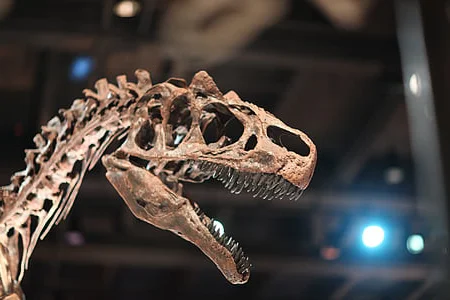
The first and most critical step in any dinosaur animation workflow is reference gathering — and this is where most animators go wrong. The instinct is to pull clips from blockbuster films and match the movement you see on screen. But those performances were designed for dramatic storytelling, not anatomical accuracy. They exaggerate speed, flexibility, and aggression in ways that have nothing to do with how these animals actually moved.
A production-quality dinosaur animation workflow starts with the skeleton. Study the joint structure, the range of motion at each articulation point, the proportions of limb segments. Then cross-reference with the closest living relatives: ratites like ostriches and emus for theropods, elephants and rhinos for large-bodied movement, crocodilians for sprawling postures and tail mechanics. Each reference teaches you something different — but none of them is the dinosaur. That distinction matters enormously.
Fix:
Dinosaur Animation Workflow Step #2: Understand Spine Rigidity and Anatomical Constraints
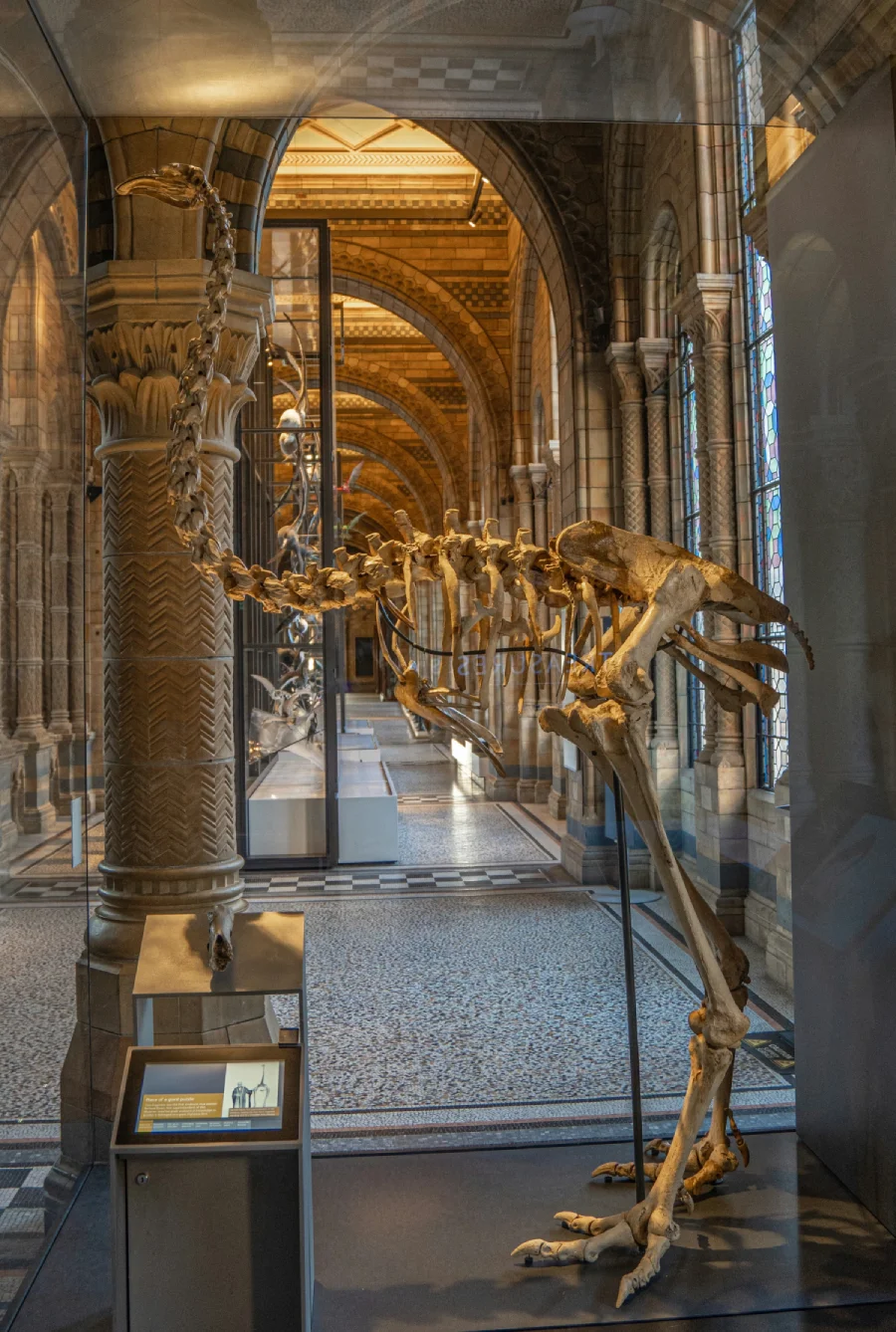
This is one of the most common errors in dinosaur animation work online: treating the dinosaur spine like a mammalian spine. Most tutorials show a fluid, wave-like torso motion borrowed from quadruped mammals — cats, dogs, horses. But palaeontological research tells a very different story.
In large theropods like tyrannosaurs, the interspinous ligaments underwent metaplasia — they partially transformed into bone-like tissue under the stress of supporting a multi-tonne body. This effectively stiffened the dorsal vertebral column, limiting lateral and vertical flex. The spine was not a whip; it was closer to a rigid beam with limited articulation points. Sauropods solved the problem differently, with ball-and-socket vertebral joints that allowed movement but in very specific, constrained patterns. Every species has its own set of rules — and if you do not know them before you start keying, your animation will feel fundamentally wrong regardless of how polished the curves are.
Fix:
This is one of the core modules in our Dinosaur Animation Course — where we break down these anatomical constraints species by species with real production examples.
Dinosaur Animation Workflow Step #3: Weight and Scale Dictate Everything
Weight is not just “slow things down.” It is the single most important factor governing every aspect of your dinosaur animation workflow — timing, spacing, foot impact, rotational inertia, and how the creature transitions between actions.
Consider the numbers. An adult Tyrannosaurus rex weighed somewhere between six and nine metric tonnes. Biomechanical simulations consistently show it was limited to roughly 17–27 km/h — a brisk walk or slow jog by human standards. A full sprint would have generated forces that could fracture the metatarsal bones. That means no high-speed chases. No sharp turns at full gallop. The physics simply do not allow it at that mass. Now compare that to a juvenile tyrannosaur, which was lighter and more gracile — and could likely reach much higher speeds. Even within a single species, weight changes the animation completely.
There is a second layer here that most reference material has not caught up with. A biomechanical study published in early 2026 concluded that the tyrannosaur foot worked far more like a bird’s than the flat-footed reconstructions most of us grew up with: the animal loaded the front of the foot rather than planting the whole sole, which points to a higher stride frequency and proportionally shorter strides than a heavy-heeled version would produce. For an animator that is not trivia. It changes the contact pose, the frame count between footfalls, and the way the body settles over each step. Heavy does not have to mean flat and plodding — a mass that lands on the front of the foot reads as controlled, not clumsy.
One of the most frequent problems in demo reels: animators apply the same speed ratios across different dinosaur species without adjusting for body mass. A five-tonne hadrosaur and a 200-kilogram raptor cannot share timing charts.
Fix:
Dinosaur Animation Workflow Step #4: Footprint Trails Tell You How They Actually Moved
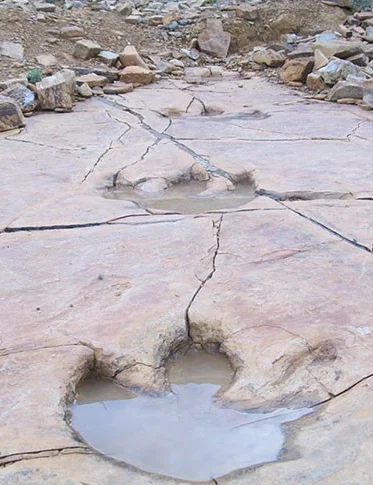
Fossilised trackways are the only direct evidence of how dinosaurs moved in life — and they are a goldmine for animators who know how to read them. Ichnology, the study of trace fossils, provides hard data on stride length, step width (gauge), foot placement pattern, and relative speed. This is not guesswork; this is measured movement.
Recent research on sauropod trackways has overturned assumptions held for decades. These giant animals did not walk with a pace gait like a giraffe, where both legs on one side swing together. Analysis of fossilised footprints shows a diagonal gait pattern — closer to how a hedgehog or beaver walks. That is a radically different animation from what most tutorials would have you create. For theropods, trackway evidence suggests a continuous speed transition rather than discrete walk-trot-run gaits like modern mammals. They modulated speed smoothly, more like modern birds.
Getting the foot-placement wrong is one of the quickest ways to break believability. If the gauge, stride, and pattern do not match what the anatomy and trackways dictate, the entire walk cycle will feel invented — because it is.
Fix:
In our Dinosaur Animation Course, we apply real trackway data directly to animation — building walk and run cycles from fossil evidence, not guesswork.
Dinosaur Animation Workflow Step #5: Translating Reference to Dinosaur — The Real Skill
This is where the actual craft lives — and it is the step that no tutorial adequately teaches. You have studied elephants for weight, ostriches for bipedal gait, crocodilians for tail mechanics. But the dinosaur is not any of these animals. It is a unique biomechanical system that has never existed in front of a camera. The translation from living reference to extinct creature is the single most difficult skill in dinosaur animation.
The process requires you to understand why each reference animal moves the way it does — not just what the movement looks like. An elephant’s column-like leg posture exists because of its mass distribution. An ostrich’s head-bob compensates for its centre of gravity shifting during each stride. A crocodilian’s lateral undulation is driven by its sprawling limb architecture. You take the underlying principle, not the surface movement, and apply it to a skeleton that has different proportions, different joint angles, and different mass.
This is where most demo reels fall apart. The animation looks like an elephant in a dinosaur costume, or a scaled-up chicken. Neither is correct. The dinosaur must feel like its own animal — with its own internal logic, its own movement signature. Achieving that requires deep anatomical understanding and the ability to synthesise multiple references into something new and coherent.
Fix:
This is exactly what separates a junior animator from a production-ready one — and it is the core of what we teach. Explore the Dinosaur Animation Course →
Dinosaur Animation Workflow Step #6: Documentary vs. Cinematic — Two Different Languages
Not all dinosaur animation serves the same purpose, and understanding the context of your shot is a fundamental part of the workflow. Nature documentary productions and blockbuster VFX films require completely different animation philosophies — even when the creature on screen looks identical.
In a documentary-style production, the goal is observational realism. The dinosaur should move as a real animal would: unhurried, efficient, with natural idle behaviours and transitions. Weight is paramount. There is no dramatic exaggeration, no anticipation held for the camera. The animation must feel like footage captured by a patient wildlife crew — the creature does not know it is being filmed.
In cinematic VFX, the animation serves the story. Timing can be compressed or stretched for dramatic impact. Scale and speed may be deliberately amplified to heighten tension. The creature might hold a pose for readability or turn towards camera for emotional impact. These are conscious choices, but they only work if the animator understands the realistic baseline first. You must know the rules before you can break them effectively.
Knowing which context you are animating for should inform every decision from the very first blocking pass — posing, timing, spacing, even the camera relationship.
Fix:
Final Thoughts on the Dinosaur Animation Workflow
A solid dinosaur animation workflow comes down to three things:
- Research the anatomy and biomechanics before you animate
- Let weight and scale drive every timing decision
- Translate reference intelligently — never copy it blindly
Skip any of these and the audience will feel it immediately, even if they cannot articulate why. Dinosaurs are among the most scrutinised creatures in VFX — getting them right requires a level of anatomical literacy that goes well beyond standard character animation.
If you are still working out how to move into this field, start with how to become a character or creature animator — then come back to this workflow once you are building shots for a reel.
Interesting Links
Evidence of Bird-Like Foot Function in Tyrannosaurus – Royal Society Open Science
How Did Sauropods Walk? Footprints Offer Clues – Science.org

Stay in the Loop
Get notified when we publish new animation insights and tutorials. No spam, just useful content.
You’re in! We’ll let you know when new content drops.
Want Personalised Feedback?
Submit your animation reel and get a free professional breakdown with specific notes on what to improve.
Get a Free Reel BreakdownMaster the Dinosaur Animation Workflow
In the course, you will learn to:
Break down real anatomy — species-specific spine constraints, joint limits, and skeletal structure translated directly into rig controls and blocking decisions.
Build movement from fossil evidence — use trackway data, biomechanics research, and comparative anatomy to create gaits that feel physically grounded, not invented.
Translate reference like a lead animator — the production-tested process for synthesising elephant, bird, and reptile reference into a dinosaur that moves like its own animal.
Guided 1-on-1 by a lead animator from major VFX studios — with real production examples, shot breakdowns, and personalised feedback on your work.
Dinosaur Animation Course